
By Rachel Williams, NACAC Communications
Los Angeles (Sept. 28, 2024) – In the wake of anti-DEI legislation taking hold in multiple states, college admission counseling professionals should continue to make decisions that are in support of their institution’s missions.
That was the advice at the final main stage session at NACAC Conference 2024 in Los Angeles. NACAC CEO Angel B. Pérez moderated a discussion with Art Coleman, founding partner of EducationCounsel; La Jerne Terry Cornish, president of Ithaca College; and Shaun Harper, provost professor at the University of Southern California.
“I’ve been in hundreds if not thousands of conversations with counsel and institutional leaders over the course of my career. In the wake of the SFFA decision and before, not one of those conversations was about getting to zero risk for litigation exposure,” said Coleman. “Not one of those conversations didn’t ultimately get framed around ‘What are we trying to achieve and what will we lose if we don’t operate in this way?’ Mission has always been in my experience the North Star of decision making.”
Coleman urged the crowd to reframe conversations around the SFFA decision and use this moment in time to reinvest and rethink strategies around recruitment, outreach, and pathways.
“We’re so obsessed right now with the rhetoric of the SFFA decision and what it told us we can’t do. We should be talking about what we can do,” he said. “If you’re talking about the case of the SFFA decision and you say, ‘That’s the case that eliminated race in admission — it did no such thing.’ It said you can’t consider racial status to advance certain diversity goals and it expressly expanded on the power of thinking through an individual student’s racial identity, experience, passions, and goals.”
The panelists discussed whether DEI needs to be rebranded, and how counselors and admission professionals can navigate working in states where there are anti-DEI laws and restrictions.
“The word ‘diversity’ has become a bad word. It’s become synonymous with blackness,” said Cornish. “Anytime you hear people talk about a DEI hire, you think about the color of the person and so we have been intentional in saying we are concerned with equity, inclusion, and belonging because ‘diversity’ is a lightning rod.”
When asked if counselors should discourage students from attending institutions in states with anti-DEI laws, the panelists all agreed that it depends on each student’s individual circumstance.
“We should not send young people into context where we know they’re going to experience harm, so the answer is to fix the harm itself,” said Harper. “It’s not about sending the young people somewhere else; it’s about addressing the harm that’s being done.”
In closing remarks, the panelists offered their advice to attendees in navigating the public’s declining faith in the value of college and in the increasingly difficult nature of meeting their institution’s enrollment goals.
“Keep doing what you’re doing. I have a pet peeve here. People are questioning the value of higher education. Mark my words: The people who are saying that are sending their students to college,” said Cornish.
This main stage session closed out the 80th annual NACAC conference. Attendees also heard from keynote speaker Earvin “Magic” Johnson about how a college counselor impacted his life, and panelists from The California State University System and the Los Angeles Unified School District about what needs to change to meet the needs of students today.
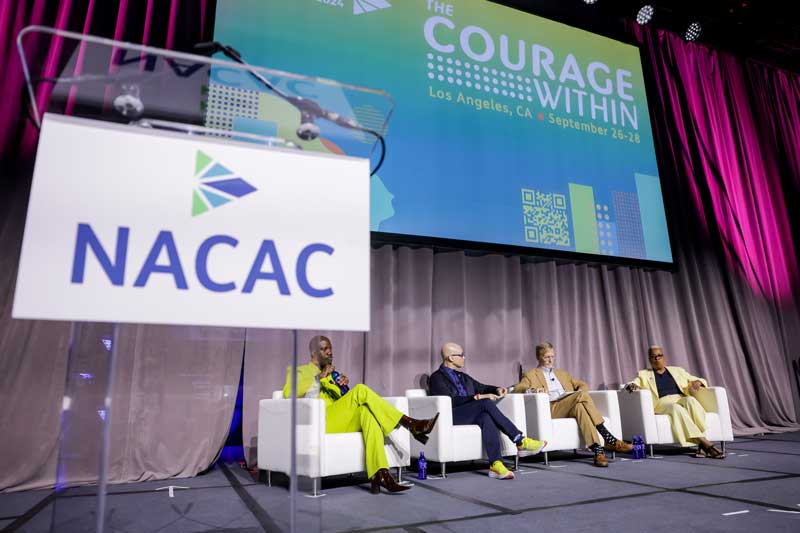
NACAC Conference 2024 closing panel, L to R: Shaun Harper, NACAC CEO Angel B. Pérez, Art Coleman, and La Jerne Terry Cornish