By Rachel Williams Sincore, NACAC Communications
Washington, D.C. (March 17, 2026) — Representing 4,000 members across 150 countries, Péter Árvai flew from Hungary to Washington, D.C. — his first visit to the U.S. capital — to advocate for policies that support international students’ studying in the U.S.
“The U.S. is losing market share of international students, but it’s still a most desired destination,” said Árvai, the vice president for global affairs of International Association for College Admission Counseling, in a meeting with U.S. Congresswoman Virginia Foxx of North Carolina. “This is an issue of global competitiveness and economics.”
International students contribute $1 billion in economic impact to North Carolina alone, said Árvai, and across the U.S. they support around 400,000 jobs. He made the international trek to participate in NACAC’s National Advocacy Day on March 16-17 to “emphasize our support for ideas that could help international students choose the U.S. again,” he said, including policies that support F-1 visas and Optional Practical Training (OPT).
Árvai was one of about 50 NACAC members and two students from Maryland who advocated for higher education on Capitol Hill on March 17. The government relations chairs of numerous NACAC affiliates coordinated around 80 meetings for National Advocacy Day participants to meet with their state representatives and lawmakers who are on critical education committees.
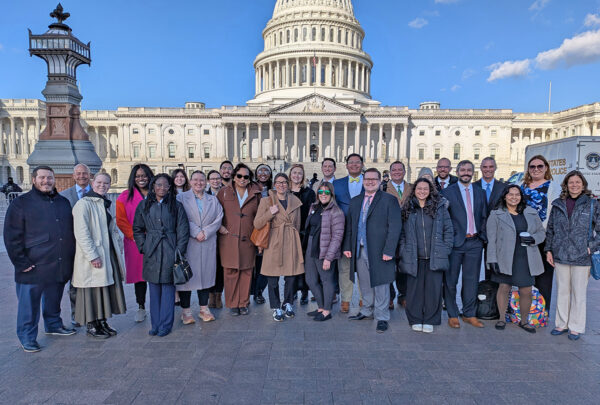
Around 50 NACAC members advocated for higher education on Capitol Hill on March 17, 2026.
During their meetings, participants urged legislators to protect and strengthen federal student aid programs, address the looming Pell Grant shortfall, ensure responsible implementation of new admission data reporting requirements, and support policies that expand college access and affordability for all students. These conversations happened at a critical time, as students and families navigate college access, financial aid uncertainty, and shifting federal policies that are affecting their access to higher education.
In his fourth time participating in NACAC’s National Advocacy Day, Nick Grenoble, government relations chair of Rocky Mountain ACAC, said he returned to Washington, D.C. this year to ensure legislators hear from people working in the field.
“I’ve been surprised how they [lawmakers] can lack awareness of how legislation is impacting things on the ground. I think there’s a lot of value in them hearing from us,” said Grenoble. One of his advocacy priorities was to support H.R. 7810, a bill that seeks to cap federal student-loan interest rates at 2 percent. NACAC endorsed H.R. 7810 earlier this month for its ability to make college more affordable for students who rely on federal loans.
Leading up to meetings on Capitol Hill, participants received a day-long briefing on March 16 from NACAC, The Presidents’ Alliance on Higher Education and Immigration, and the National Association of Student Financial Aid Administrators (NASFAA). Attendees were briefed on the $11.5 billion shortfall the Pell Grant faces in fiscal year 2027 and the Admissions and Consumer Transparency Supplement (ACTS) revision to IPEDS. ACTS is a new mandate of most U.S. higher education institutions that requires thousands of new admission data fields be submitted to the federal government in what critics say is the Trump administration’s way of creating fear among institutions that are seeking to create diverse campus communities.
“It’s important that we all get to the Hill to talk to our representatives about the work we do on a daily basis,” said NACAC Board of Trustees member Johnnie Johnson, who attended the preparation meeting on March 16. “Relatability is so important. If you can talk to them [lawmakers] about their college journey, their college search, that’s your way in.”
National Advocacy Day is an annual event for NACAC members. Recent NACAC advocacy efforts helped preserve funding for critical federal education programs and helped ease data reporting requirements under ACTS. Read more about NACAC’s advocacy efforts, led by Director of Advocacy Sean Robins, and view resources to help you advocate in your own communities year-round.