
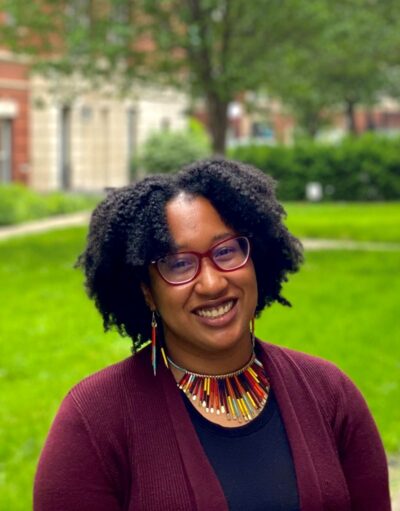
 Safiya Johnson
Senior Assistant Director of Admission, Access Messaging
Northwestern University (IL)
What drew you to the world of college admission counseling?
As a former Pell recipient whose closest high school and college friends were mostly other first-generation and/or lower-income (FGLI) students, the ability to dedicate my life to helping other FGLI students blaze trails and set out on new journeys drew me in. In college, I had an internship sponsored through the admissions office where I helped a local high school’s college counseling team. Through that internship, I thought I wanted to start my career as a school-based college counselor. But various college-based admissions counselors convinced me we need advocates on this side of the desk as well. The travel was a perk. But my North Star has always been expanding access to college, helping students tell their stories, and breaking down the admissions process.
Looking even further back, my first-ever internship was in high school working for my high school counseling office. I helped incoming freshmen navigate the adjustment to a rigorous, diverse, magnet high school through a summer bridge program. I just love supporting students and families through periods of transition.
What is your favorite part of the job?
Unpopular opinion: Reading season is my favorite part of the job because you get to meet so many change agents, proud trailblazers, and community leaders from across the world! It’s a pleasure to get to know prospective students through their own words and their supporters’ words. During reading season, you get to meet more students than you were able to reach through travel. But many times, students describe their communities and why they’re proud of them in their applications. Being able to read prospective students’ applications — and perhaps interact with students from that same or neighboring community the following year — is inspiring, every time. But my absolute favorite part is learning about so many pockets of the world through students’ essays.
A very, very close second favorite part that I want to acknowledge is how prospective students constantly push me to keep learning and to break concepts down in new ways when presenting and traveling. In the end, it’s the students and their stories.
How has NACAC played a role in your career?
NACAC helped me become a published author! I wrote two articles for The Journal of College Admission, which opened the door to numerous conversations and presentations on codeswitching and bias in letters of recommendation. I appreciated the ability to engage in a strong professional development community, especially during that period when I worked outside a university and (notably) during the pandemic. Those articles opened up a world of new connections.
I also am a big advocate of the GWI conference. I was lucky enough to serve as a GWI faculty member in New Orleans. The connections I made attending GWI have carried over post-conference and continue to enrich my practice.
I also love attending the NACAC conference, taking copious notes, and sharing them with my office post-conference. Those notes have generated good conversations. Lastly, I want to shout-out the NACAC education team, because I really appreciate the on-demand NACAC session recordings. Those take the pressure off missing sessions at the conference.
Overall, I appreciate NACAC for allowing me to network with caring professionals, challenging me to always put students and families first, and helping me grow as a professional.
What do you think is the biggest challenge facing our profession today?
This is a tough one. However, the increasing legislative and non-legislative actions to reroute or reduce funding for colleges and programs that expand access to college — seemingly due to dwindling public faith in higher education — is, to me, the biggest challenge facing our profession. Yes, we have long had advocacy channels to push for increased funding and college affordability. However, it feels like the discourse around whether college is worth investing in and whether it can be a major driver of social mobility, despite the data, is turning into something I haven’t seen before.
Discourse influences policy and vice versa. I worry the vilification and skepticism of higher education will reach an inflection point that will (re)shape our work. Still, let’s not be deterred. We must keep up the fight and advocate for and with our students and families. Thanks to NACAC and the regional ACAC leaders and members for your efforts.
When you aren’t working, what do you like to do?
I love supporting my friends who are activists, organizers, and creatives in Chicago. I’m biased, but I think Chicago is a great city to live in. I love being in community and supporting my friends who are dedicated to the arts and building stronger communities across Chicago, whether through a comedy show, film or play talkback, or community event. I will leave my house to support a friend. That and trying to plan the next time I see my baby niece and nephew.
What five words would you use to describe yourself?
Empathetic, optimistic, resourceful, curious, connector.
Published March 9, 2026