
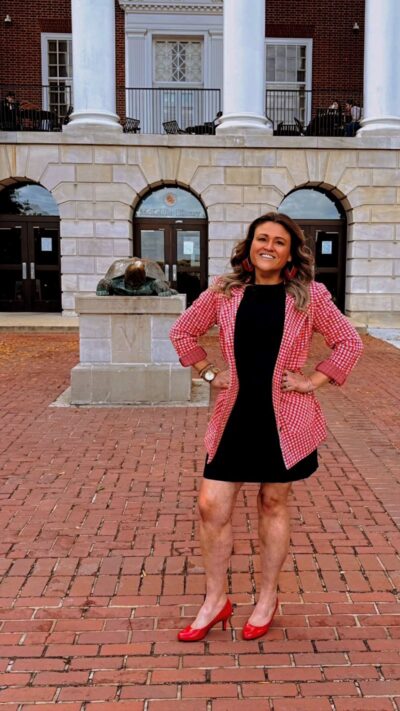
 Rosemary Martín Edwards
Associate Director of Undergraduate Admissions
University of Maryland, College Park
What drew you to the world of college admission counseling?
My story begins with my parents, two brave Peruvians who migrated their family to the United States in search of opportunity and the chance to dream. They came carrying little more than hope, work ethic, and big dreams for their children. Growing up as a first-generation Peruvian American, I learned early what it meant to live between worlds: translating for my family while navigating spaces that did not always understand or value our language, our traditions, or our culture. My parents taught me to be unapologetically myself, to lead with love, to fight for what is right, and to lift others as I rise.
After 18 years of my mother cleaning homes and my father taking any work he could find, they made the heartbreaking decision to return to Peru during the fall of my freshman year of college. I chose to stay to continue pursuing the dream they had sacrificed so much to begin. That decision felt heavy and lonely at the time; suddenly, I was on my own, navigating everything from financial aid and housing to basic survival. But it became the foundation of my courage.
College changed my life. I found a home in my alma mater, Shenandoah University (SU), my lacrosse team, and professors who saw potential in me even when I doubted myself. I became an unasked-for expert in financial aid and social services, working four jobs to stay afloat. By 21, I was balancing full-time work in SU’s IT department while finishing my degree.
During my senior year, just before graduation, my father passed away in Peru. It was a devastating loss, yet it fueled my determination to keep going and to make him proud. Five years later, after I earned my master’s degree, my mother also passed away, but not before achieving one of our family’s proudest moments. Having once put aside her own education to raise her children, she returned to law school in Peru and earned her J.D., fulfilling her lifelong dream. This triumph was a reminder that education transforms not only individuals but generations.
Their courage and sacrifice to fight hard so that my siblings and I could have the opportunity to dream is the reason I do this work. This work is bigger than any one of us and carries a higher purpose. Every student we meet or have the opportunity to interact with may be the one student or family who needs us the most. Knowledge is power, and I feel blessed to have found this profession. Having the ability to change even one life — or the world — in the smallest way is enough for me.
What is your favorite part of the job?
My favorite part of the job is translating what can often feel like an overwhelming process so that every family has the opportunity to learn and understand. The gift of understanding provides a palpable sense of confidence in families and students. They start to breathe easier, believe they can, and feel empowered by a more level playing field.
Working directly with students and families can sometimes be challenging because college admission can be such a demanding and competitive environment. You can easily become either the resource or the target. This job has taught me that I have the ability to help ease some of those anxieties by breaking things down in ways that make sense, regardless of where someone begins in their understanding of the process. Seeing students and families walk away feeling confident and empowered to keep moving forward is one of my favorite parts of the job.
I am also reminded, from my years as a college counselor, that these are still students, and they deserve the space and time to enjoy the journey.
How has NACAC played a role in your career?
NACAC has played a transformative role in both my professional and personal journey. It has given me a community that feels like home — a space to learn, grow, and serve alongside people deeply committed to access, equity, and student success.
Over the years, I have served in several capacities, including as a past NACAC delegate, past president of PCACAC, long-time former conference chair, and currently as the NACAC Hispanic/Latine SIG leader. I am also deeply reflective writing this, as it has been 10 years since I received the individual NACAC Rising Star Award in San Diego, yet I still carry the same gratitude and inspiration that moment gave me.
During my time in the presidential cycle for PCACAC, I was introduced to my fellow Affiliate Presidents Council members, who became a new family of leaders — passionate, generous, and brave individuals who share the same purpose. Through the NACAC LEAD program, we experienced one of the best forms of professional development I have ever received. It stands as a testament to how NACAC continues to focus on and invest in cultivating leaders at both the affiliate and national levels.
NACAC has reminded me that this work is not meant to be done alone. It is a community rooted in connection and advocacy, and NACAC has given me the courage to lead authentically and use my voice to open doors for others.
What do you think is the biggest challenge facing our profession today?
One of the biggest challenges facing our profession is ensuring that access and equity remain at the center of our work while navigating constant change. We face shifting policies, affordability concerns, and questions of trust in higher education, yet we must never lose sight of the individual student behind every application and story.
These challenges are not only systemic but deeply human. At this current time, I personally have concerns for students who are living in fear or affected by ICE raids across the country. Being in Washington, D.C., and witnessing these moments is heartbreaking and sends a message that students should suppress their dreams rather than pursue them. I hope these fears do not influence this year’s application cycle or future college attendance for students who deserve to see higher education as a place of hope and belonging.
With institutional budget cuts, the daily challenges and demands of our work, and the rising expectations in an increasingly competitive environment, it is essential that we make space to care for those doing this work too. We must continue to build a community that cannot be defeated. As we say in my country, “Una comunidad unida jamás será vencida.” Through unity, we find strength and create spaces that value wellness, compassion, and belonging.
When you aren’t working, what do you like to do?
I love to travel and experience new cultures, music, and people. Living in D.C. is a gift, and I enjoy exploring the city I call home. It’s a cultural melting pot and the diversity of thought, unpredictability, and vibrance make it such an inspiring place to be. I also love spending time with friends and family, and have recently refocused my energy on self-care and health. You can often find me at the gym, in a Pilates class, biking, hiking, golfing, skiing, or enjoying a good glass of red wine with great company. And of course, I have a passion for music and love going to concerts. I can never resist dancing, especially when a salsa tune hits.
Despite what some may think, I am not always an extrovert. I treasure my quiet moments with a candle, a good book, or a movie. I especially love my mornings, when I can start the day with peace and gratitude.
What five words would you use to describe yourself?
Apasionada. Auténtica sin disculpas. Decidida. Inspiradora. Centrada.
Passionate. Unapologetically authentic. Determined. Empowering. Grounded.
Published Dec. 29, 2025