
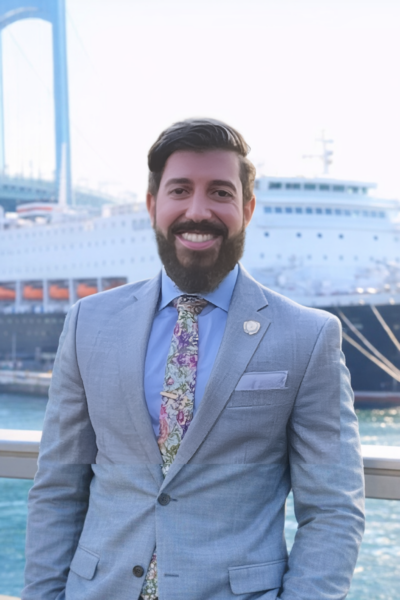
 Alex El Helou
Associate Director of Admissions
Maritime College, State University of New York
What drew you to the world of college admission counseling?
It is equally what drew me and who held me. I began my path in counseling while in college, though not initially in admissions. I worked with students and adults in a veterans medical center and in a jail and house of correction. As a first-generation student, I understood the importance of education but also the barriers to access and understanding. I witnessed firsthand how further education can dramatically change the trajectory of a person’s life, opening doors to opportunity and increasing both their value and impact in the world. I saw a problem and wanted to help contribute to its solution.
I started as a college adviser with a community-based organization serving two Title I schools, providing underrepresented students with the guidance and knowledge I wish I had at their age. From there, a colleague, Ted Mallwitz, encouraged me to transition to an institution, where I had the privilege of supporting Opportunity Program students and others. Along the way, professionals like Rohan Howell and Danny Robinson have shown me that meaningful change in this field doesn’t always have a clear path, but impact is made one step at a time.
I came to realize that while I didn’t know exactly what I wanted at the start, the work I stumbled into — guiding students, helping them navigate access, and seeing them graduate — is exactly what I needed. It fills my cup to contribute to and witness students overcome barriers, shift their socioeconomic trajectory, and grow into positive contributors in the world. Professionals who have significantly influenced my career, like Carlos Cano, have further taught me the value of giving back and supporting the next generation of professionals, which has become a central part of my own journey in this field.
What is your favorite part of the job?
Engaging with complex problems requires intentional and thoughtful solutions. I am energized when I can collaborate with colleagues to develop enrollment strategies that are both institutionally sustainable and deeply student-centered, with the goal of expanding access and advancing equity in education. This work requires balancing mission, data, and advocacy, and I find that intersection especially meaningful. I also try to challenge myself to continuously learn new skills and take on work that pushes me outside of my comfort zone, including developing new strategies and finding innovative ways to maximize the capabilities of our CRM. Early in my career, a mentor encouraged me to approach the profession as a “jack of all trades,” emphasizing the importance of curiosity and developing a broad understanding of the field.
I also value the collaborative nature of this field. Through my involvement with NYSACAC, and at the national level through NACAC, I have had the opportunity to learn from professionals with diverse perspectives who challenge my thinking and push me to expand my vision. Just as importantly, this career has given me the opportunity to give back to others in the field, building on the mentorship I received early on. I strive to follow the “campsite rule” by leaving this profession better than I found it, with the ultimate goal of helping dismantle barriers to education.
How has NACAC played a role in your career?
Being able to attend NACAC events has provided several opportunities for growth in my career. The conferences and programs have allowed me to connect with professionals from across the country and internationally, which has broadened my perspective on the work happening throughout the field. These conversations help me reflect on how I can bring new ideas back to my institution to better support students and strengthen our enrollment efforts.
Many of these experiences began through my involvement with my state affiliate, NYSACAC, which opened the door to deeper engagement with NACAC. Through that pathway, I had the opportunity to participate in the inaugural NACAC Next cohort and later become involved in additional committee and mentorship opportunities. I have also been fortunate to meet and learn from many respected professionals in the field, and those conversations have added meaningful layers to my professional development.
What do you think is the biggest challenge facing our profession today?
One of the biggest challenges facing our profession today is navigating the increasingly complex political and policy landscape surrounding higher education. Enrollment management requires balancing institutional priorities related to access and attainment while responding to evolving policies affecting admissions practices, diversity initiatives, and federal or state oversight.
These changes influence how students and families perceive institutions and can make the college search process more complicated. Students are not only evaluating institutional fit and affordability, they are also considering campus climate and how broader political dynamics may impact their experience. At the same time, institutions are preparing for the demographic realities of the enrollment cliff, which places additional pressure on enrollment teams to meet institutional goals while continuing to do right by the student.
Because of this, our profession faces the challenge of maintaining a commitment to ethical admission practices, access, and equity while adapting to a rapidly changing policy environment and shifting demographics. Supporting students through this complexity while advocating for fair and transparent processes will remain critical to the future of our field.
When you aren’t working, what do you like to do?
When I am not working, I value routines that help me stay grounded. While enrollment management is dynamic and no two days are the same, my mornings are intentionally consistent. I start my day at 4:30 a.m. and I’m at the gym by 5 a.m., which serves as my peaceful sanctuary for self-care. I typically finish my workout with some boxing before heading into the office. Outside of work, I enjoy decompressing with family and friends and exploring new food experiences whenever I can.
If you could be any fictional character, who would it be and why?
For me, it would be Spider-Man. Growing up, my older brother, Ramy, passed down his Spider-Man comics to me, which sparked both my curiosity for science and my appreciation for how the character navigates very real, human challenges. What has stayed with me most is the principle, “with great power comes great responsibility.” That idea resonates deeply in my professional life, where access, influence, and voice carry an ethical obligation. Early in my career, my other brother, Dave, reminded me that it is important to use our platform to promote what is right, not just what is popular. Guided by that mindset, I strive to use my role and voice to elevate conversations around equity, access, and inclusion, even when the work is difficult or uncomfortable. I believe progress is built through consistent, values-anchored effort — showing up, doing the work, and remaining accountable even when the impact is not immediately visible.
Published April 13, 2026