
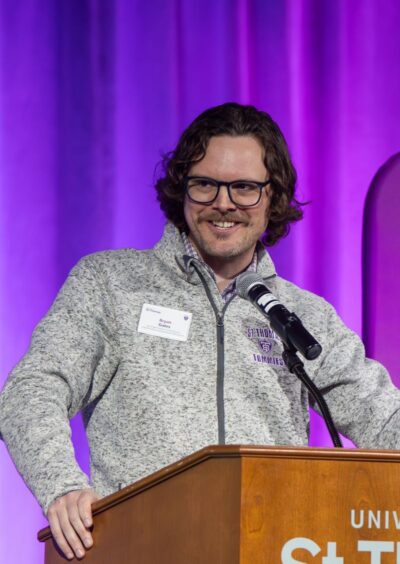
 Bryan Gates
Associate Director of Admissions
University of St. Thomas (MN)
What drew you to the world of college admission counseling?
I was drawn to college admission counseling in a way that feels both intentional and coincidental. My mother was a teacher, and my father was passionate about leadership and strategy, so I grew up in a home where education and teamwork were constant themes. This profession became a natural intersection of those influences. Some days I get to let students know they are on track and encourage their character. Other days I get to brainstorm recruitment strategies or team goals.
Like many folks in college admissions, someone on my college campus saw something in me and encouraged me to consider this work. That simple tap on the shoulder made a lasting impression and shaped how I think about mentorship and inviting others into the profession.
I often tell students, half-jokingly, that you can’t major in “Admissions Counseling.” But I feel fortunate to have been guided toward a career that reflects the values I grew up with and continues to challenge and inspire me through the students and colleagues I work alongside.
What is your favorite part of the job?
What I love most about this work is the chance to pay forward what others once gave me. When I was navigating my own college decision, there were people who showed up with care, guidance, and belief in my potential. Later, through my involvement with MACAC, experienced professionals did the same, encouraging me to step into leadership. Now, I get to be part of that support system for others. Whether it’s advocating for equity, offering clear and honest guidance, or affirming students and colleagues along the way, that sense of shared investment is what guides me.
I’m also especially energized by working with new professionals. Onboarding is one of the most dynamic parts of my role. Even with the challenges that come from the natural turnover in our cycle, I genuinely enjoy meeting new team members, building relationships, and helping them find purpose and excitement in college admissions.
How has NACAC played a role in your career?
I remember my first NACAC conference in Indianapolis. I was in awe of the scope of our profession. Prior to that experience I had a limited understanding of how our state operated and of other colleges in the Midwest. Walking into the general attendee sessions and seeing how many folks were engaged in this conversation was remarkable.
Since then, NACAC conferences have become an annual reset for me, a space to reflect, learn, and reimagine what’s possible. I always return to Minnesota with pages of ideas, new questions, and a renewed sense of purpose. It’s where my thinking gets stretched and redirected in the best way.
I’m excited this year to be able to help host that space for all of us. We are looking forward to gathering our members in Minnesota for NACAC’s annual conference this October. It’s pretty full circle for me, as it will coincide with my year serving as president for MACAC. I can’t wait to show the city that I love to all the friends I’ve met over the years. Minnesota is a space where national questions are being worked on at a local level. Our neighborhoods reveal the complexity of our work and the hope that drives it. Minneapolis should be an ideal gathering place for the discourse and reflection that has been so valuable to me and NACAC over the years.
What do you think is the biggest challenge facing our profession today?
I think one of the biggest challenges facing our profession is that, for too long, we have allowed college admissions to feel like a black box. That sense of mystery has often been mistaken for rigor or prestige. In reality, it has created confusion, anxiety, and a perception that the process is inaccessible or subjective. When students and families don’t understand how decisions are made, they are more likely to fill in the gaps with assumptions, usually ones that heighten pressure and reinforce inequities.
This lack of transparency disproportionately impacts students who don’t have access to experienced counselors, legacy knowledge, or well-resourced school communities. For them, the “hidden curriculum” of admissions — how to build a college list, how applications are evaluated, what actually matters — can feel impossible to navigate.
My hope is to actively clarify that mystery. This creates a greater sense of agency for students rather than fear. Being more transparent about how we read applications, how we make decisions, and actual costs isn’t just good communication, it’s a form of advocacy.
When you aren’t working, what do you like to do?
I live in South Minneapolis with my family and we love our city. Summers are spent biking to the city lake beaches together. Winter weather is celebrated by still trying to be outdoors as much as we can. We mix in a lot of my three daughters sports and activities each night. I love to visit the Boundary Waters Canoe Area in Northern Minnesota with friends and family. Pristine nature and peace are a sacred space for us. Our house is constantly filled with music and each of us gets a chance to DJ as long as the space is full of soul, sound, and dance.
What five words would you use to describe yourself?
These are things I care about and try to integrate into my life: Service, Relationships, Gratitude, Education, and Joy.
Published May 18, 2026