
By Rachel Williams Sincore, NACAC Communications
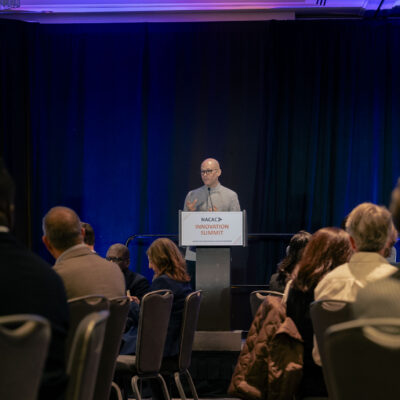
NACAC CEO Angel B. Pérez delivering opening remarks at the Innovation Summit.
Washington, D.C. (March 26, 2026) — A few years ago, members of the NACAC community asked: Is the college admission ecosystem truly serving students the way it should?
Findings from national surveys, committees, research, and conversations with leaders across the field all agreed: No, and change is not optional; it is overdue.
It's with that in mind that NACAC launched the Center for Innovation in College Admission last year not to simply study the challenges facing the college admission counseling field, but to help lead its transformation at a systems level.
On March 26, more than 130 education change-makers from around the country convened in Washington, D.C. for NACAC's inaugural Innovation Summit — a conference where forward-thinkers of the profession came together with a goal to rethink, redesign, and reimagine the college admission system to better serve students and institutions.
"The Center for Innovation is not designed to solve these challenges alone," said Pérez in his opening remarks. "Its greatest strength is its ability to convene — to bring together the very best thinking in our field to tackle our toughest problems and design a future that does not yet exist."
Erwin Hesse, director of the center, added, "As college admission professionals, we must be open to public, transparent, and sometimes critical reviews of our own processes. We should explore new systemic-level, future-facing ideas today, and nurture them into tomorrow's common, everyday standard."
To help achieve systems-level change, attendees engaged in design-thinking and problem-solving activities around the center's three pillars.
- How to redesign the structures of college admission to better serve students and institutions.
- To rethink how we define and assess merit and readiness.
- How to foster the next generation of professionals in the college admission counseling workforce.
Attendees also learned about innovations already underway in the profession, including interactive transcripts, direct admission policies at the state level, artificial intelligence in admission, and alternative ways to advise students in their college and career choices, to name a few.
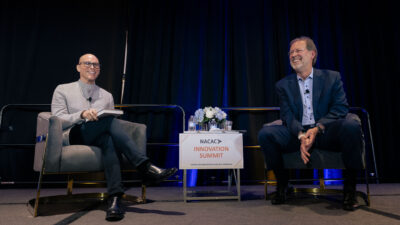
Angel B. Pérez and Dan Porterfield, president and CEO of the Aspen Institute, discussing how to create systems-level change.
Attendees heard from Dan Porterfield, president and CEO of the Aspen Institute who this summer will take the helm of the Jack Kent Cooke Foundation. In a fireside chat with Pérez, he told the crowd that he recommends engaging in brand research before attempting change at the systems level.
"How are we viewed and valued by those who know us? We learned a lot about how we're perceived and our strategies were grounded in that awareness," Porterfield said of previous systems-change projects he's been part of.
Panelists talked about innovations happening in their respective areas and opportunities for the center to help bring them to scale.
For instance, Diego Arambula, vice president of educational transformation at the Carnegie Foundation for the Advancement of Teaching, told attendees about Carnegie's new Opportunity Colleges and Universities (OCUs) designation. It recognizes institutions that are creating access for young people in their communities and that are positively impacting their lifetime earning trajectories.
"Seventeen percent of institutions are [accomplishing this] and it's amazing," said Arambula. "And now we have other institutions asking, 'How can I?'"

Erwin Hesse, director of the Center for Innovation in College Admission.
Other panelists included the CEO of Common App and institutional leaders from Skidmore College, Georgia Tech, Washington College, University of Pennsylvania, Boston University, NACUBO, and more. They each spoke of challenges they're facing in admission, in equitably serving students, and in nurturing the college admission and counseling workforce. They also spoke of ways they hope the center can help identify and elevate solutions.
The center is supported by Alexander Clark, founder and CEO of Slate; Lumina Foundation; and the Youth Thriving Through Learning Fund.
"I propose that we orient admissions to focus on young people thriving," said Peter Ross, managing director of the Youth Thriving Through Learning Fund in his remarks. "What would that mean? The new center gives us an incredible opportunity to do just that."
For more information about the Innovation Summit, see the Center for Innovation in College Admission website and follow NACAC for updates.