
By Rachel Sincore, NACAC Communications
WASHINGTON, D.C., Sept. 17 — The policy decisions made by the federal government have far-reaching consequences for students, families, and communities. They have a profound impact on what postsecondary opportunities are available to them, how they pay for them, and, ultimately, on the health and strength of the U.S. workforce.
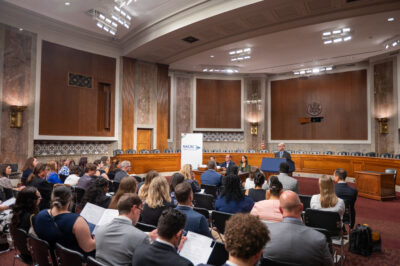
In a Capitol Hill briefing on Sept. 17, that’s the message NACAC leaders and members brought directly to Congressmembers and their staff.
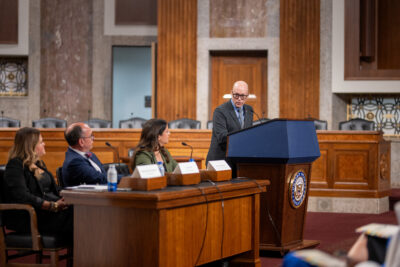
NACAC CEO Angel B. Pérez moderated the discussion.
“The decisions made here ripple outward — through families, communities, institutions, and ultimately, our nation,” NACAC CEO Angel B. Pérez told the crowd of attendees. “And this is an especially consequential moment. Higher education is experiencing significant change, accompanied by an intense national conversation about admission, affordability, access, accountability, and the value of postsecondary education.”
Pérez called NACAC members “agents of opportunity,” as they help young people see possibilities for themselves that they may not yet be able to see. They help students understand their options for meaningful postsecondary education and employment, navigate complex systems, and secure opportunities for social and economic mobility. When that happens successfully, these students enter the workforce, contribute to the nation’s economy, and help drive the future of the country.
That’s why Pérez and panelists urged attendees to consider how federal policies can strengthen support for school and college counselors and admission systems and can support students’ ability to afford a postsecondary education. Panelists included Jennifer Nuechterlein, college and career counselor at Hunterdon Central Regional High School (NJ), David Burge, senior vice president for enrollment and student achievement at George Mason University (VA), and Rosemary Martín Edwards, associate director of undergraduate admissions at the University of Maryland, College Park.
“One of the many hats we wear is to help students find their best-fit,” said Nuechterlein, adding that could mean earning a college degree, attending a trade or technical school, or entering the workforce. “Students want individualized support and attention. I liken it to going to the doctor … you don’t want to share your symptoms in a room of 100 other people. But with caseloads of 500, 600, even 700 students per one school counselor, sometimes there are shortfalls and that can be really detrimental for some students and their futures.”
Legislatively, we have a long way to go on this issue, said Pérez, citing NACAC research that shows 17 percent of U.S. high schools have no school or college counselor at all. For those that do, Nuechterlein said greater funding for their professional development is critical.
“Investing in school counselors is not investing in one individual; it’s investing in a community,” she said. “College and career readiness [knowledge] is vast, and it’s just one piece of what school counselors do. We need more of us and more of us who have resources and are knowledgeable.”
Burge and Martín Edwards advocated for affordability measures, a greater understanding of how college admission systems work, and to remove the barriers for international students to study in the U.S.
“We must fully fund the Pell Grant and eliminate the shortfall,” said Burge. “We cannot meet the workforce demands of the state of Virginia alone without bringing more low-income students to and through higher education.”
Martín Edwards added: “We need federally funded college-access programs like TRIO and GEAR UP, and support for HBCUs, tribal colleges, Hispanic-serving institutions, and others that support all communities of students.”
The NACAC Capitol Hill Briefing was supported by Senator Tina Smith of Minnesota and her staff, who helped secure the space on Capitol Hill.
For more information on NACAC’s advocacy efforts and ways to be involved, visit the Advocacy in Action webpage.